What is a hazard?
When it comes to workplace health and safety, being able to identify and report hazards is an important part of keeping your people and property safe. In a workplace context, a hazard is defined as something with the potential to cause harm or adversely affect a person’s health.
Hazards can vary across industries and different working environments, with some hazards posing more severe and immediate threats to safety than others. That said, it is important to take reporting and addressing all hazards seriously. If you want to maintain a positive health and safety culture, everyone in your workplace should take responsibility for reporting hazards and make the appropriate changes to mitigate any risk.

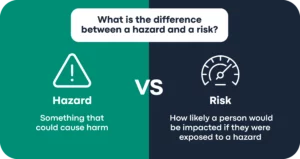
What is the difference between a hazard and a risk?
Sometimes the words hazard and risk are used interchangeably but they are two distinct elements of workplace health and safety. While a hazard is something that could cause harm, risk refers to how likely a person would be injured or impacted if they were exposed to that hazard.
Some hazards, like temporarily working at a desk in a chair that is not adjusted to support your back, pose a relatively low level of risk. Other hazards, such as working with corrosive or toxic substances, come with much higher levels of risk. The actions you take to mitigate these hazards should reflect the relevant risk level.
What are the different types of hazard?
There are several common types of hazard that you might encounter in a workplace. Certain hazards are found in most workplaces; others are more prevalent in specific industries. Here are some examples of each type of hazard.
Safety
A safety hazard broadly includes any working conditions that could cause harm, injury or a fatality. For many workplaces, safety hazards are the most common that you might encounter. Examples of safety hazards include spills or trip hazards, unguarded machinery or equipment, or electrical hazards like exposed wires or broken plug sockets.
Physical
Physical hazards are a form of environmental hazard. They can cause harm to a person without any interaction with the hazard itself, deliberate or otherwise. This includes long-term exposure to UV rays, working in extreme temperatures (hot or cold), several forms of radiation including micro- and radio-waves, and exposure to loud noise.
Chemical
Another type of environmental hazard are chemical hazards. In some industries, working with acids, flammable materials or pesticides would be routine. However, chemical hazards can also be posed by more commonplace items, like cleaning products, paints or solvents.
Psychological
The way that your workplace is organised and ran can create psychological hazards for your employees. Short- and long-term anxiety or stress caused by excessive workload, a lack of training or a lack of support from colleagues can be just as serious as other psychological hazards, like workplace bullying or harassment.
Ergonomic
Physical strain and long-term injuries are caused when workers’ bodies are exposed to ergonomic hazards. These hazards can include poor workstation set-ups, regular heavy lifting, awkward or repetitive motions, and working with force or vibration.
How can you mitigate the risks posed by hazards?
Whenever you identify a new hazard in your workplace, the first step to reducing the risk involved is to report it. Whatever reporting system you have in place, employees at all levels of your organisation should feel confident and able to report hazards as and when they encounter them.
When a hazard is reported, you can then decide what changes to make to reduce the level of risk as much as reasonably practicable. You should be able to prevent the hazard from causing an incident or accident.
Depending on the type of hazard and the level of risk posed, you might decide to update your manual handling processes, repair faulty equipment, arrange staff training to educate and upskill employees or implement brand new procedures. Once the changes are in place, it’s important to continually monitor and review the impact of your adjustments to keep safety standards high.
How Notify can help you to identify and report hazards
Making use of digital safety software is an effective way to identify, report and track hazards in your workplace. Notify’s Incident Reporting software makes it easy for your teams to report hazards, near-misses and accidents, without the need for complicated spreadsheets or time zapping paper based forms.
With our free-to-use mobile app, employees can identify and report hazards on the go, creating real-time updates that managers can respond to wherever they are. Thanks to our automated notifications, you can implement corrective actions quickly and assign tasks to specific team members to mitigate any potential risk. Employees can also keep track of their hazard report, helping to drive engagement and a proactive safety culture.If you’d like more information on how Notify can help you proactively manage hazards in your workplace, book a demo today.
What are the best tools for hazard reporting and safety management?
The best tools for hazard reporting and safety management are the ones that make it effortless for people to report issues early, while giving leaders the structure and visibility to investigate, fix root causes, and track improvement over time. In practice, that means choosing a platform that combines fast reporting, strong workflows, and real-time insight, not just a basic form.
What to look for in a hazard reporting and safety management tool
- Quick, mobile-first reporting for hazards, near misses, observations, accidents, injuries, and unsafe conditions
- Offline reporting and flexible capture options (e.g., QR codes) for frontline environments
- Photo evidence and location context (e.g., GPS tagging where appropriate)
- Standardised data entry (pick lists, categories) to improve reporting quality and trend analysis
- Automated alerts for serious or high-risk reports so leaders can respond immediately
- Action management to assign corrective and preventative actions and track them to completion
- Investigation and root cause support to move beyond “what happened” to “why it happened”
- Offline reporting and flexible capture options (e.g., QR codes) for frontline environments
- Dashboards and analytics to identify patterns, hotspots, and leading indicators
- Feedback loops that keep reporters informed and strengthen engagement and trust
Why Notify is a strong choice
Notify is a safety management platform designed to give organisations a 360° view of risk. It makes hazard reporting simple through its Incident Management module. Teams can report hazards, near misses, accidents, and observations instantly using any device, helping you capture issues early before they escalate.
Notify also supports faster response and better follow-up by:
- Triggering alerts for high-priority reports and enabling you to create, assign, and track actions immediately, so investigations and corrective steps can start without delay
- Providing clear visibility of investigation progress and tracking corrective/preventative actions through to completion
- Enabling reporting from any device, including offline capture (with automatic syncing when connectivity returns), plus options like QR code reporting for quick access on site
- Making it easy for employees (and, where relevant, contractors or supply chain partners) to submit reports with photos and contextual details, improving the quality of investigations
- Improving consistency with pre-defined pick lists (e.g., hazard types and causes) and features like speech-to-text to speed up reporting for frontline workers
- Supporting a stronger reporting culture with tools that encourage participation and close the loop, like feedback to the reporter, helping to build trust and psychological safety
With Notify, organisations can reduce paperwork, strengthen compliance, and unlock real-time insight into safety performance – so you can act earlier, learn faster, and proactively reduce workplace risk.